
Daokong GongSTANDING PRACTICE中文
A record of the teaching lineage

Teacher & tradition

Meet the people
behind the practice.

Get to know Zeng Jianqiao, the teachers who guided him, and the experiences and writings that shape his approach.

Start exploring
DAOKONG GONG · EVERYDAY PRACTICEA record of the teaching lineage

What would you like to explore?

Start with a question that matters to you.

See all topics

01 / Teacher & Tradition

Meet Zeng Jianqiao

Teaching near Wutong Mountain in Shenzhen, China

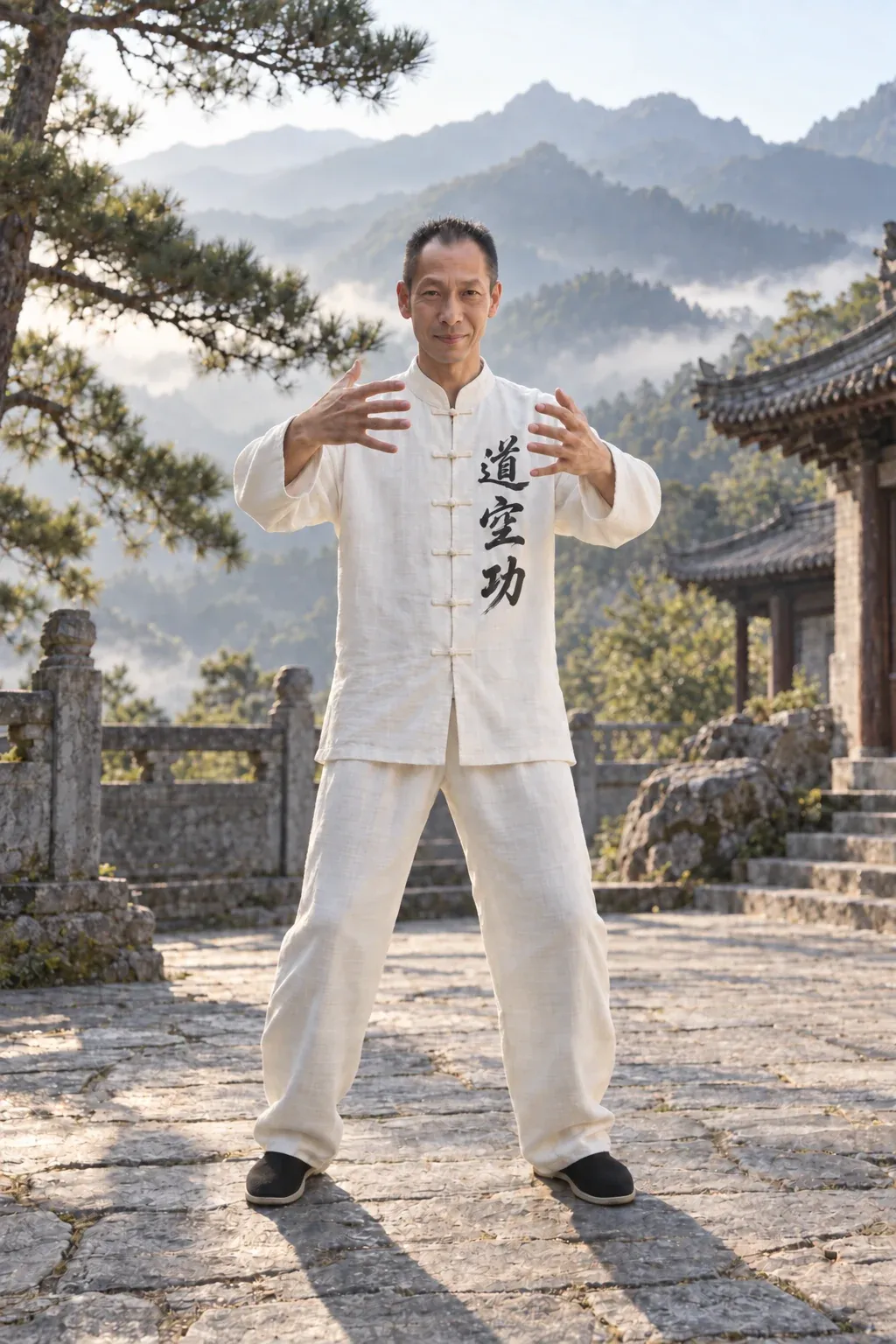
Zeng Jianqiao · standing practice portrait

Zeng Jianqiao teaches Daokong Gong as a way to care for the body and cultivate the heart and mind. His students often call him Shifu, a respectful Chinese term for a teacher in a close learning tradition.

He brings the teaching back to practice: stand, notice, learn, and keep things natural. He describes a path that begins with the body and extends to becoming more openhearted and caring toward other people.

The Chinese expression xiuxin, often translated as “cultivating the heart-mind,” includes both our inner habits and how we act. In this setting, it means learning to respond with less defensiveness, more patience, and genuine care—not simply trying to feel peaceful during a session.

In his own account, business difficulties and the death of his wife led to a very difficult period in his health and daily life. Meeting teacher Xu in Shenzhen’s Huanggang Park brought him to standing practice and a new beginning.

That history helps explain why he teaches. It is his personal account, not evidence that standing practice can treat an illness or replace medical care.

Biographical passages are based on the supplied oral and written accounts.

02 / Teacher & Tradition

Why he teaches

Making room for more people to learn

Observation and conversation

Visitors often ask about fees and what it means to become a student. Zeng’s stated aim is to keep the practice accessible: regular fees for people who can afford them, with charitable teaching where appropriate for those who genuinely cannot. The team confirms individual arrangements.

He describes using income from business to support the teaching. This gives practical meaning to the phrase yi shang yang dao: supporting the continuation and sharing of the practice through earnings from business.

He also draws a clear line between teaching and selling products. Learning Daokong Gong is not bundled with supplements or nutritional goods.

His longer-term hope is to help create welcoming courtyards where people can practice, care for themselves, and learn together. That is an aspiration, not a claim that a nationwide network already exists.

03 / Teacher & Tradition

The teachers who shaped his practice

First, learn to stand. Then, learn not to force.

A record of the teaching lineage

Zeng recalls meeting Xu Mai in Huanggang Park in Shenzhen. Xu was a longtime Dachengquan practitioner connected with Zhang Houwu’s teaching.

Xu asked how he was doing and invited him back the next day. He then helped Zeng take a basic standing posture. The starting point was simple: stand and begin to learn from the experience.

Later, Xu introduced him to Zhang Houwu. Zeng remembers Zhang placing increasing emphasis on standing, naturalness, and letting go of unnecessary complication. The teaching did not ask students to pursue supernatural powers.

Zeng associates Xu with the invitation to stand and Zhang with the reminder to keep the practice natural. One provided a clear beginning; the other helped him avoid turning the method into something rigid.

Some details of the wider lineage, including formal titles and generations, still need to be checked across records. A lineage title alone cannot explain the quality of a person’s practice or teaching.

04 / Teacher & Tradition

In the teacher’s own words

Keep the conversation and its context together

Zhang Houwu and Zeng Jianqiao

The teaching materials return to several themes: breathing naturally, noticing the body, learning a form without clinging to it, and being willing to begin again.

We plan to share full conversations once the recordings, speakers, dates, and context have been checked. A line from a conversation can sound very different when separated from the question it answered.

Where a recording or transcription is unclear, we will leave the question open rather than turn a guess into the teacher’s words.

05 / Teacher & Tradition

Read the source texts

A starting guide to the writings behind the practice

Zeng Jianqiao with students

Reading and practice can inform each other. These texts offer context for the ideas used on this website, but a passage reprinted in several books is still one source.

Yi Wu Zhi Jing brings together writings by Wang Xiangzhai, students’ notes, later essays, and editorial material. It is important to distinguish those voices rather than attribute everything in the collection to Wang.

The English descriptions below are reading aids, not official published English titles.

If you are wondering… Start with Look for
Where does standing fit within Yiquan? Quandao Zhongshu — an overview of the practice Foundations, whole-body coordination, release, and natural breathing
Why practice standing for wellbeing? Zhan Zhuang Gong Mantan — a discussion of standing practice The relationship between body and attention, exercise and rest
How did standing for wellbeing develop? Yangsheng Zhuang Jianjie — an introduction to standing for health Its relationship to Xingyiquan standing practice
What does “breathe naturally” mean? Zhan Zhuang Gong (Draft) Avoiding fixation on prescribed bodily points or imagined energy circuits
How do posture and intention work together? Zhan Zhuang Gong (Draft) How each informs the other, without neglecting either

When a passage is difficult, bring the question back to practice and discussion. A memorable line can invite exploration without becoming a rigid instruction for every person.

06 / Teacher & Tradition

Understanding the lineage

What the records tell us, and what remains open

Teachers and friends together

Written teachings

Wang Xiangzhai’s writings on standing and wellbeing help explain the relationship between form and intention, effort and rest. They provide an important reference for the practice.

Personal recollections

The accounts supplied to us describe Zeng Jianqiao learning with Xu Mai and Zhang Houwu. They preserve valuable details about how the teaching was experienced and passed on.

Questions still to check

Some earlier connections, generations, formal titles, and names remain uncertain. We will not turn those gaps into a definitive family tree. Where accounts differ, the difference should remain visible until it can be clarified.

07 / Teacher & Tradition

Preserving the story carefully

Respect includes asking clear questions

Zhang Houwu and Zeng Jianqiao

A teacher’s memories can tell us about relationships, difficult periods, and small moments that shaped a practice. They deserve care, including a clear distinction between personal recollection and independently checked history.

Where possible, we keep the recording, date, speaker, and surrounding conversation. We compare different versions, follow up unclear names and dates, and say when something is still unknown.

This allows future students to ask questions and understand the tradition without having to accept every story as established fact.

Your next step:
begin with standing.

Explore ways to learn